Etymology Atlas
Type a word. See how 1,500+ languages say it on a world map — and trace it back to the roots it grew from, thousands of years ago.
Try it with “water” →Search any English word
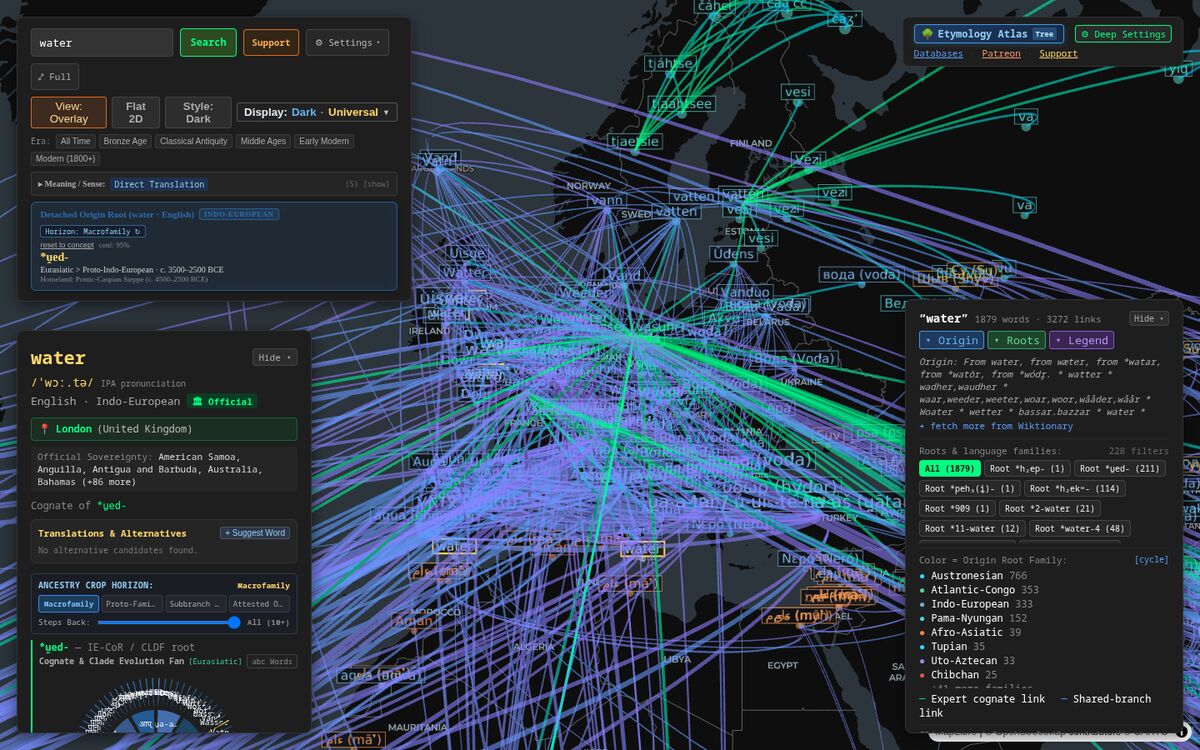
Every dot is a language, placed where it is spoken. Lines connect words that share an ancestor, and colours show the language family — Indo-European, Austronesian, Afro-Asiatic and hundreds more.
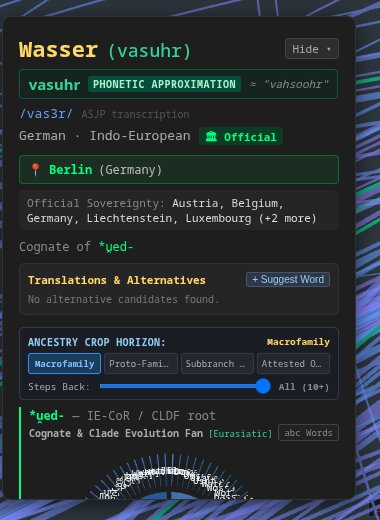
Tap a word to open its card
See its pronunciation, language family, the countries where it is official, and the ancestral root it descends from — here German Wasser, from Proto-Indo-European *wed-, the same root as English water, Russian voda and Greek hydor.
Think a translation is wrong? Use + Suggest Word on the card.
Follow the roots
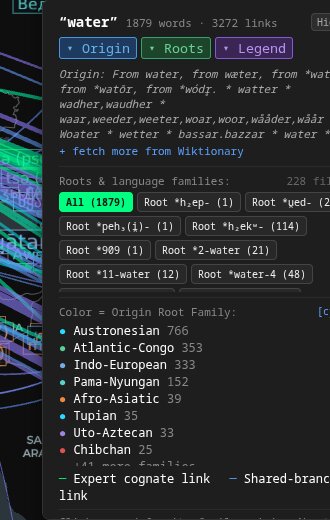
The roots panel lists every ancestral root behind the word and how many languages inherited each one. Click a root to highlight its descendants, or browse by language family.
Travel back in time
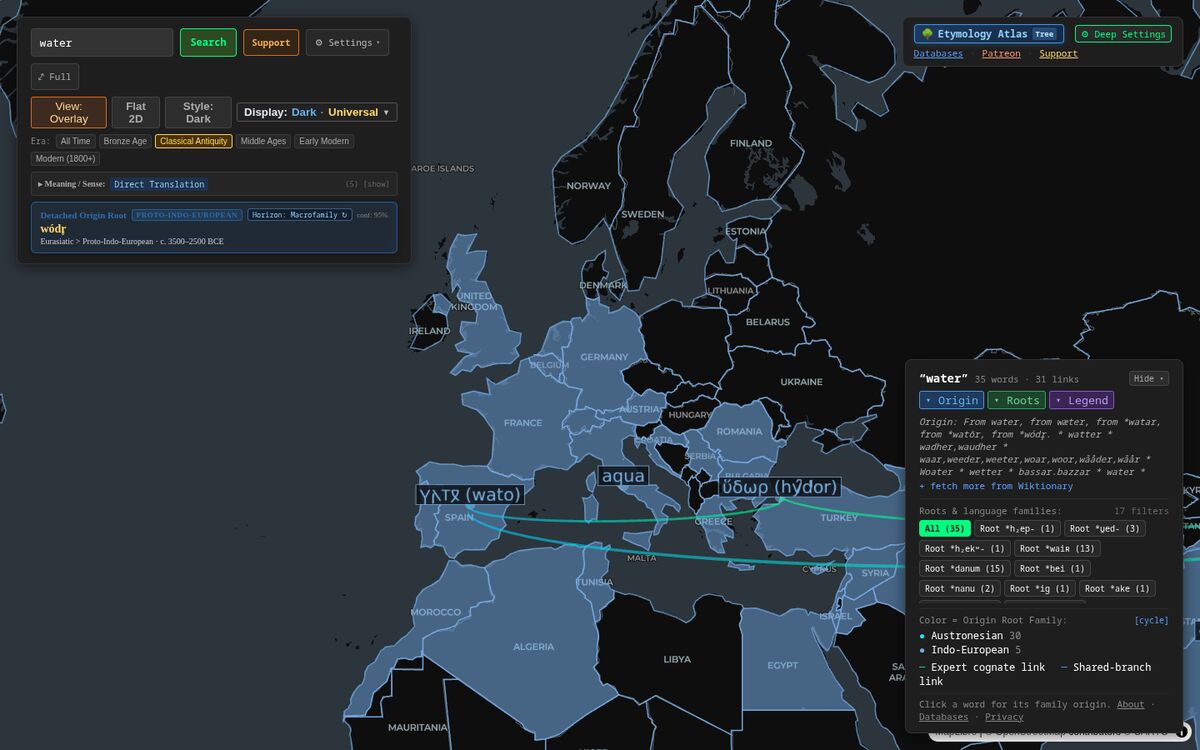
Pick an era — Bronze Age, Classical Antiquity, Middle Ages — and the map shows only the forms attested then. In Classical Antiquity, “water” becomes Latin aqua, Ancient Greek hýdōr and Proto-Indo-European *wódr̥.
Explore the family tree
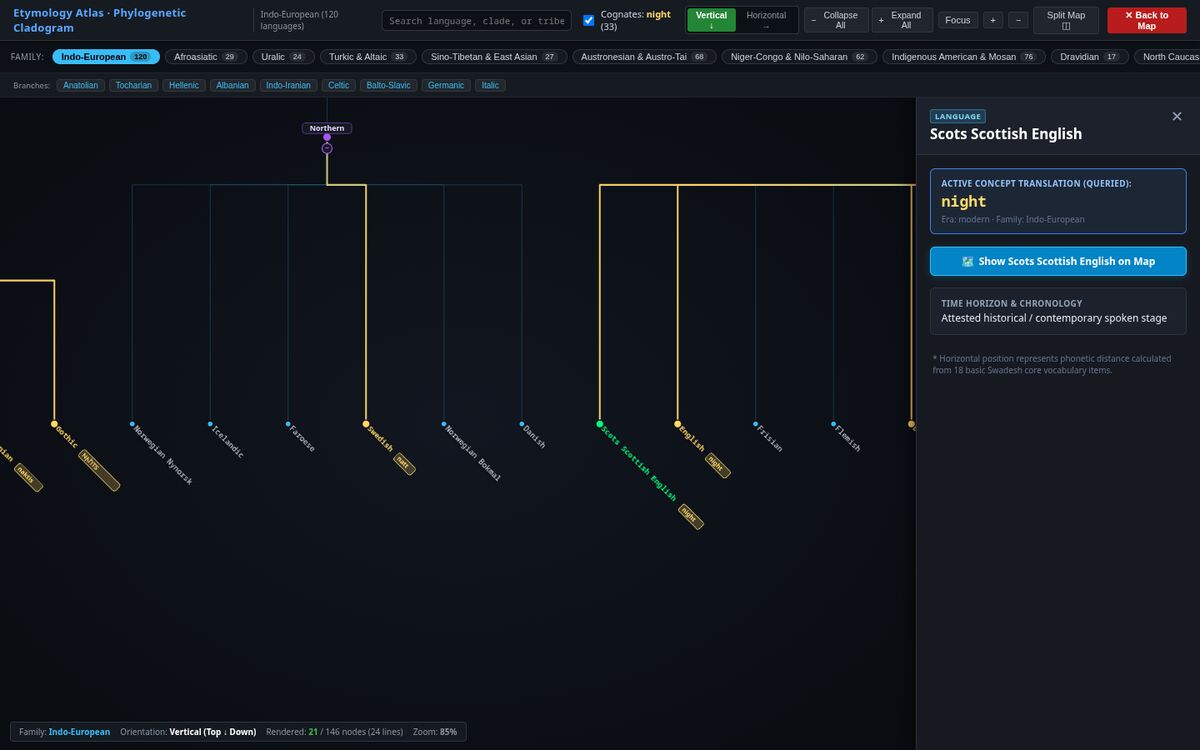
Open 🌳 Tree to see languages as a branching tree: how English, Scots, Frisian and Flemish branch off within Germanic, with the searched word highlighted on the tree.
Words with surprising family trees
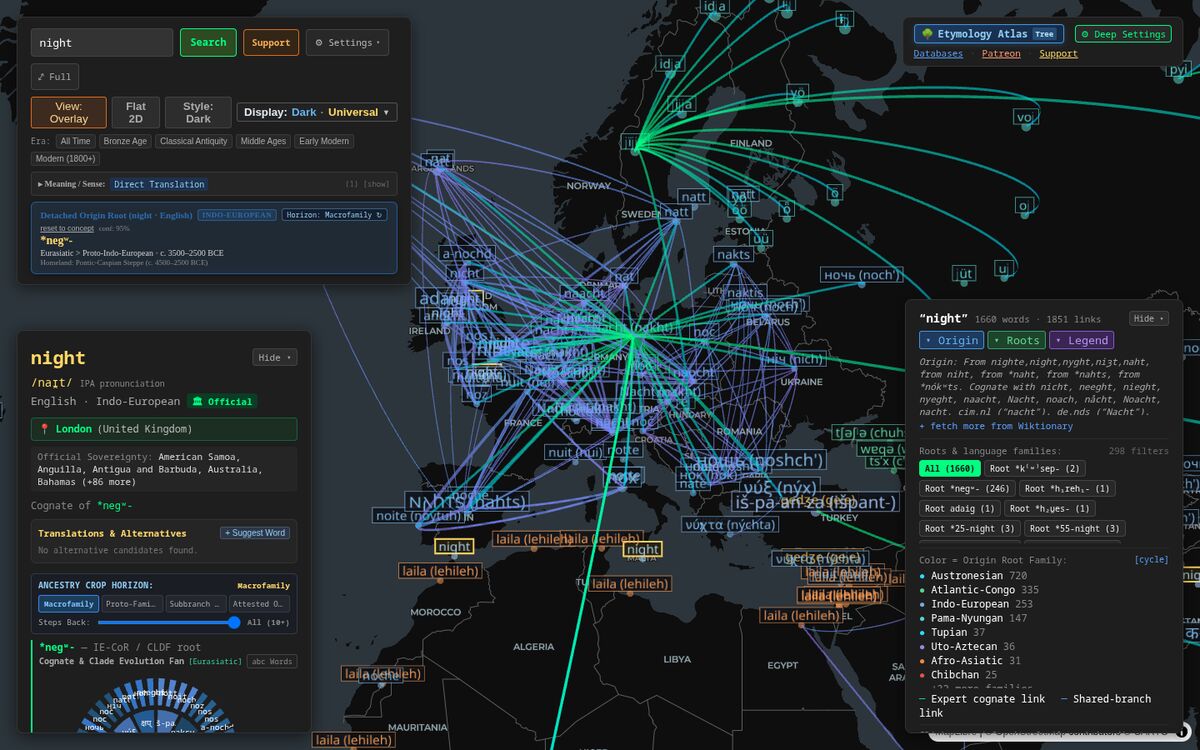
night — Nacht, noche, nox, nicht, noch':
still recognisably one word across Europe, from a root about 5,000 years old.
heart — related to Greek kardía (as in cardiac) and Latin cor (as in courage).
salt — Latin sāl, Greek háls, Russian sol': one ancient root.
Where the data comes from
Translations and cognates come from peer-reviewed comparative datasets — IE-CoR, ABVD, UraLex, ASJP and other CLDF collections — plus Wiktionary, Wikipedia and Apertium dictionaries. Each source is credited on the databases page.
Ancient and reconstructed forms (such as *wódr̥) are hypotheses published by linguists, shown with their source. We check that every one of them matches the dataset it cites. Modern translations come from several sources of varying quality, so if something looks wrong, please suggest a fix on the word card.